
· 11 min read
How Much Equity Should You Give Up at Pre-Seed? (With Real Numbers)
Most first-time founders ask "what valuation should I raise at?" The better question is "how much of my company should I sell?" Valuation is a headline. Dilution is what you actually lose.
The short answer: most pre-seed rounds sell between 10% and 20% of the company. Under 10% is a great outcome. Over 25% at pre-seed is a warning sign, because it leaves too little for the rounds that come after.
This guide shows you how to work out your own number, the hidden dilution most founders miss, and five ways to keep more of your company.
Why this one number matters so much
Every round dilutes everyone who owns shares before it. Small differences at pre-seed compound by Series A.
Here is the same company, with two equal co-founders, raising three rounds:
| Event | Disciplined path: founders keep | Aggressive path: founders keep |
|---|---|---|
| Today | 100% | 100% |
| Option pool created | 95% (5% pool) | 85% (15% pool) |
| Pre-seed | 85.5% (sold 10%) | 66.3% (sold 22%) |
| Seed | 70.1% (sold 18%) | 49.7% (sold 25%) |
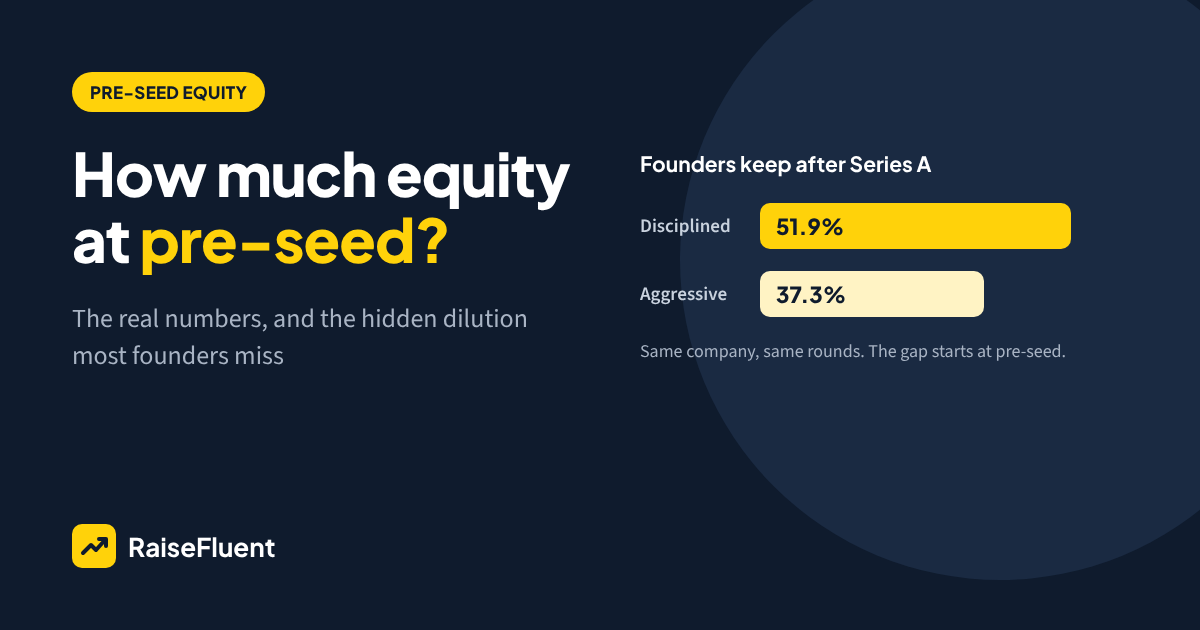
| Series A | 51.9% (after pool top-up and 22% sold) | 37.3% (sold 25%) |
Same company, same three rounds. One team still controls the company after Series A. The other does not. Almost all of that gap comes from decisions made at pre-seed.
A useful rule: keep at least 70% for the founders together after your seed round, and at least 50% going into Series A.
How to work out your number in three steps
Step 1: Decide what the money must achieve
Start with the milestone, not the amount. What do you need to prove before your next raise? Usually it is a product in market plus early revenue or strong usage.
Then cost it: team, product, marketing and overheads until you reach that milestone, plus a buffer. Most pre-seed rounds aim for 18 to 24 months of runway.
If you need $40,000 a month and want 18 months, you need about $720,000.
Step 2: Find a realistic valuation range
Look at recent rounds of companies like yours: same stage, sector and region. At pre-seed, valuation mostly reflects the team, the size of the problem and any early proof (a working product, a waitlist, letters of intent, first revenue).
Step 3: Do the maths
On a post-money SAFE or a priced round, the share you sell is simply:
Amount raised ÷ post-money valuation = equity you give up
Raising $500,000:
| Post-money valuation | Equity you give up |
|---|---|
| $2,500,000 | 20.0% |
| $4,000,000 | 12.5% |
| $5,000,000 | 10.0% |
| $8,000,000 | 6.25% |
If your number comes out above 20%, you have three options: raise less, raise later with more proof, or find zero-dilution money first.
You can run your own numbers in seconds with the free dilution calculator and pre-money vs post-money calculator.
The hidden dilution most founders miss
The headline percentage is rarely what you actually give up. Watch these three things.
1. The option pool
Investors usually ask you to set aside shares for future hires, the option pool, and they ask for it to be created before their money comes in. That means the founders pay for all of it.
A 15% pool created before the round can cost you more than the round itself. At pre-seed, with few hires planned, a 5% pool is easy to defend. Grow it to 10% at seed when you are actually hiring. Model it with the free option pool calculator.
2. Stacked SAFEs
SAFEs feel small one at a time: 7% here, 10% there. But several SAFEs at different caps add up, and on post-money SAFEs every new one dilutes only the founders.
Example: $300,000 at a $3M cap (10%), then $400,000 at a $4M cap (10%), then $350,000 at a $5M cap (7%). That is 27% gone before your seed round even starts.
Fix: add every SAFE to one cap table the day you sign it, and set a limit in advance, for example no more than 20% on SAFEs. The free SAFE calculator shows what each one converts into.
3. Pre-money versus post-money caps
With a post-money cap, the investor's percentage is fixed and later SAFEs dilute only you. With a pre-money cap, everyone shares the dilution. Many founders model one in their spreadsheet and sign the other. Read which one your document says.
Five ways to give up less
- Use zero-dilution money first. Grants, cloud credits, startup competitions and customer prepayments cost no equity. Selling 100 founding memberships before launch also gives you the best proof an investor can see.
- Raise after a milestone, not before. The same $500,000 might cost 16.7% at the idea stage and 6.3% with early revenue.
- Raise smaller, sooner. A tight round that reaches one clear milestone beats a big round at a low valuation.
- Negotiate the option pool, not just the valuation. Ask for a smaller pool sized to your real hiring plan, created after the round if possible.
- Get several term sheets. Competition between investors moves valuation more than any argument you can make.
A quick pre-seed checklist
- I know the milestone this round must reach and what it costs
- My raise covers 18 to 24 months of runway
- I have checked recent valuations for companies like mine
- I have modelled the option pool and every SAFE on one cap table
- I know whether my caps are pre-money or post-money
- Founders keep at least 80% after this round
- Founder shares vest over 4 years with a 1-year cliff
- A startup lawyer in my country will review the documents
Frequently asked questions
Is giving up 20% at pre-seed too much?
20% is at the high end but common, especially for a first institutional round. Above 25% at pre-seed starts to make later rounds hard, because investors want founders to keep enough ownership to stay motivated.
How much equity should advisors get?
Usually between 0.25% and 1% each, vesting over 2 to 4 years. Give equity only for real, ongoing help, and put it in writing.
Does a SAFE count as dilution if it has not converted yet?
Yes. It converts at your next priced round, so treat it as dilution the day you sign. Model it at the valuation cap to see the worst case.
How big should the option pool be at pre-seed?
Around 5% is usually enough at pre-seed. Expand to about 10% at seed, when you start hiring key people.
The bottom line
There is no single right percentage, but there is a right process: decide the milestone, cost it, find a realistic valuation, then check the hidden dilution before you sign. Founders who do this keep meaningfully more of their company by Series A.
Want to go deeper? Download the free eBook Fund or Fold for the full guide to when and how to raise, or join the waitlist for the RaiseFluent Fundraising Kit, which includes a 5-year financial model, an instrument and dilution guide, investor lists and negotiation templates.
This article is general education, not legal, tax or investment advice. Have a qualified professional in your country review any fundraising documents.
The Fluent Founder
One practical fundraising lesson every week, from real deals. Free.