
· 12 min read
Liquidation Preference Explained: Who Gets Paid When You Sell
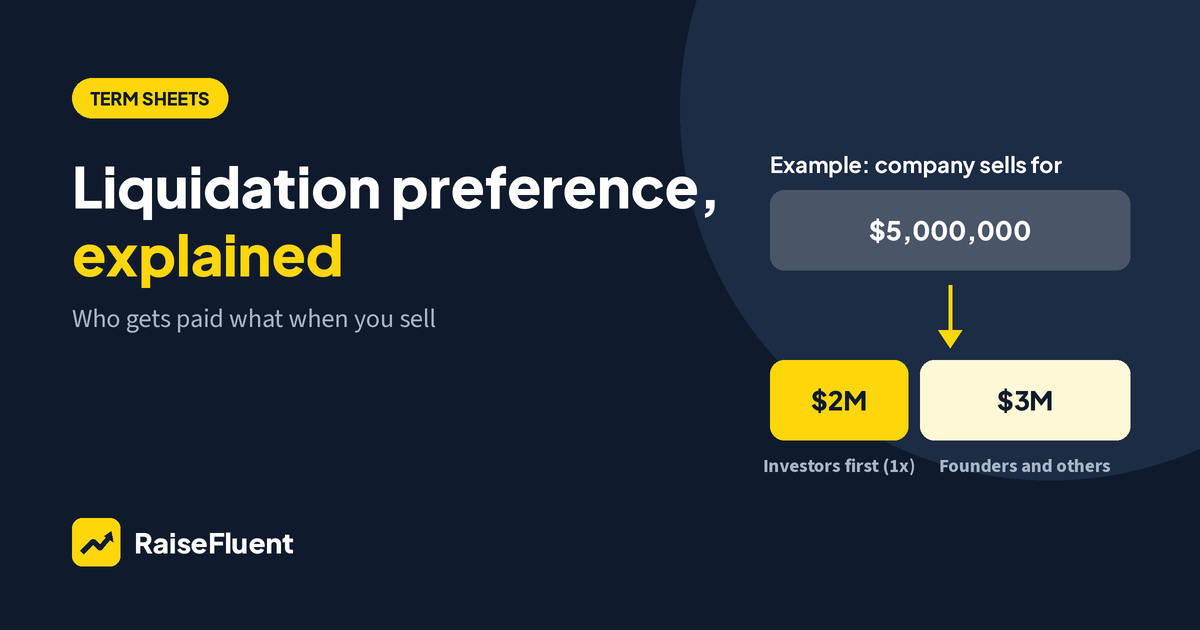
A liquidation preference is the right of investors to get their money back, before founders and employees receive anything, when your company is sold or wound up. The most common version is a 1x non-participating preference: the investor gets either their money back or their share of the sale, whichever is larger.
It is one of the most important terms in any term sheet, and one of the least understood. In a big exit it barely matters. In a modest exit, which is the most common kind, it can decide whether founders walk away with millions or with very little.
This guide shows you exactly how liquidation preferences work, with numbers, so you can spot a bad term before you sign it.
FREE CALCULATOR
Liquidation Preference Calculator
See who gets paid what at any exit value.
Why liquidation preferences exist
Investors who buy preferred shares take a big risk. If the company sells for less than expected, a preference protects them from losing their money while founders, who often paid almost nothing for their shares, keep a large share of the proceeds.
That protection is reasonable. The problem is that some versions go well beyond protection and shift a large share of the money to investors even in decent exits. Knowing the difference is the whole game.
The three things that define a preference
Every liquidation preference comes down to three questions:
- The multiple. How many times their investment do investors get back first? 1x is standard. 2x or 3x is aggressive.
- Participation. After taking their preference, do investors also share in what is left? Non-participating means no. Participating means yes.
- Seniority. If there are several rounds of investors, who gets paid first? Later investors are often senior, or everyone shares equally (pari passu).
Let's take each one with the same simple company.
The example company
An investor puts $2,000,000 into your company and owns 20%. Everyone else (founders, employees and the option pool) owns the other 80%. We will call them "founders and others".
1x non-participating: the standard
With a 1x non-participating preference, at a sale the investor chooses the larger of:
- their preference: 1 × $2,000,000 = $2,000,000, or
- their ownership share: 20% of the sale price
Sale at $5,000,000:
- Preference: $2,000,000
- Ownership share: 20% × $5,000,000 = $1,000,000
- The investor takes the preference: $2,000,000
- Founders and others share $3,000,000
Sale at $30,000,000:
- Preference: $2,000,000
- Ownership share: 20% × $30,000,000 = $6,000,000
- The investor converts to shares and takes $6,000,000
- Founders and others share $24,000,000
The crossover point is easy to find: the investor converts once 20% of the sale is more than $2,000,000, which happens above a $10,000,000 sale. Above that, the preference does not change the split at all.
This is why a 1x non-participating preference is considered fair and founder-friendly. It protects the investor's money in a weak exit, and steps aside in a good one.
Participating preferred: the double dip
With a participating preference, the investor gets their preference and their ownership share of what is left.
Sale at $5,000,000 with a 1x participating preference:
- The investor takes $2,000,000 first
- $3,000,000 is left, and the investor takes 20% of it: $600,000
- The investor receives $2,600,000 in total
- Founders and others share $2,400,000
Compare that with the non-participating case: founders and others get $600,000 less from the same sale.
Sale at $30,000,000 with a 1x participating preference:
- The investor takes $2,000,000, then 20% of the remaining $28,000,000, which is $5,600,000
- The investor receives $7,600,000, instead of $6,000,000
- Founders and others share $22,400,000, instead of $24,000,000
Participation never "steps aside". It takes money from founders at every exit value. That is why it is often called double dipping.
Some term sheets add a cap on participation, for example "participating up to 3x". Once the investor has received three times their money in total, they stop participating and are better off converting to ordinary shares instead. A cap softens the term, but non-participating is still better for founders.
FREE EBOOK
Get the free Fund or Fold eBook
19 chapters, free by email.
Higher multiples: 2x and above
A 2x preference means the investor gets two times their money before anyone else.
Sale at $10,000,000 with a 2x non-participating preference:
- Preference: 2 × $2,000,000 = $4,000,000
- Ownership share: 20% × $10,000,000 = $2,000,000
- The investor takes $4,000,000
- Founders and others share $6,000,000
With a 1x preference, the same sale would have given founders and others $8,000,000. The multiple moved $2,000,000 from founders to the investor.
Multiples above 1x usually appear in difficult rounds, when a company is short of cash or raising at a lower valuation. If you see one in an early-stage term sheet, treat it as a red flag and negotiate.
Seniority: when there are several investors
Once you have raised more than one round, the order of payment matters.
Imagine a seed investor with a $2,000,000 preference and a Series A investor with an $8,000,000 preference, both 1x non-participating. Total preferences: $10,000,000. The company sells for $8,000,000, and neither investor would get more by converting.
Standard (stacked) seniority, Series A paid first:
- Series A takes the full $8,000,000
- Seed gets $0
- Founders and others get $0
Pari passu (paid equally, in proportion to their preferences):
- Series A gets 80% of $8,000,000 = $6,400,000
- Seed gets 20% of $8,000,000 = $1,600,000
- Founders and others get $0
In both cases, founders receive nothing, because the total preferences ($10,000,000) are larger than the sale price. This is the "preference overhang", and it is why founders should keep an eye on the total amount of preferences stacked on top of their shares, not only the terms of each round.
Quick comparison
Using our example investor ($2,000,000 for 20%):
What founders and others receive:
| Sale price | 1x non-participating | 1x participating | 2x non-participating |
|---|---|---|---|
| $5,000,000 | $3,000,000 | $2,400,000 | $1,000,000 |
| $10,000,000 | $8,000,000 | $6,400,000 | $6,000,000 |
| $30,000,000 | $24,000,000 | $22,400,000 | $24,000,000 |
Notice the pattern: at a big exit, the 2x non-participating investor converts and the term stops mattering, while participation keeps taking a share at every price.
FREE CALCULATOR
Term Sheet Comparison
Compare offers side by side, including the preference.
From the deal room: same price, very different outcomes
A pattern I have seen more than once goes like this. Two companies in the same sector each raise about $8,000,000 in total over two rounds. A few years later, both are acquired for roughly $20,000,000, a solid but not spectacular exit.
The first company raised on clean terms: 1x non-participating at every round. At $20,000,000, the investors convert or take their money back, whichever is larger, and the founders and team share most of what is left after that.
The second company accepted a 1x participating preference in a hurried bridge round, and later investors asked for the same terms to stay consistent. At the same $20,000,000 sale, investors first take their $8,000,000 back and then also take their ownership share of the remaining $12,000,000. If the investors own about 40%, that is another $4,800,000. The founders and team receive about $7,200,000 instead of about $12,000,000 at the first company.
Same sector, same funding, same sale price. The difference was a term that looked minor at the time it was signed, because everyone was imagining a much bigger exit.
How to negotiate liquidation preferences
- Ask for 1x non-participating. It is the most common early-stage term and easy to defend as standard.
- Trade, don't just refuse. If an investor insists on participation, ask for a cap, or offer a small valuation concession in exchange for removing it.
- Watch the total stack. Add up every preference across all rounds and compare it with realistic exit values, not just your dream outcome.
- Ask about seniority early. Find out whether new investors want to be senior or pari passu with earlier ones, and what that means at a modest exit.
- Model it before you sign. Run three exit values: disappointing, fair and great. If the disappointing one leaves founders with nothing, push back.
FUNDRAISING KIT
Fundraising Kit waitlist
Lock the $249 early-bird price. No payment now.
Common mistakes founders make
- Only modeling the big exit. Preferences matter most at modest sale prices, which are the most likely outcomes.
- Accepting participation as standard. It is not standard at early stage. Non-participating is.
- Ignoring later rounds. Each new round adds preferences on top of yours. The total stack is what decides your payout.
- Confusing a high valuation with a good deal. A high valuation with a 2x or participating preference can leave you worse off than a lower valuation with clean terms.
- Not asking for help. Have a startup lawyer review every term sheet. This guide helps you understand the terms, not replace legal advice.
FAQ
What is a liquidation preference?
It is the right of investors to get their money back, before founders and employees receive anything, when the company is sold or wound up.
What does 1x non-participating mean?
The investor gets either their original investment back or their ownership share of the sale, whichever is larger, but not both. It is the most common early-stage term.
What is participating preferred stock?
Participating preferred investors get their money back first and then also receive their ownership share of whatever is left. It shifts money to investors at every exit value.
Is a 1x liquidation preference normal?
Yes. A 1x non-participating preference is the standard term in most early-stage rounds.
Can I negotiate liquidation preferences?
Yes. It is one of the most important terms to negotiate, and often more important than a small difference in valuation.
Your next step
Before you sign a term sheet:
- Test three exit values in the free Liquidation Preference Calculator.
- Read the full framework in the free Fund or Fold eBook, which covers how to read and negotiate the terms that decide your outcome.
Mohit Patel has spent 10+ years on both sides of the deal table, working with 750+ founders and business owners and 2,500+ investors. He is the author of Fund or Fold and the founder of RaiseFluent. Connect on LinkedIn.
This article is educational and not legal, tax or investment advice. Examples are illustrative.
The Fluent Founder
One practical fundraising lesson every week, from real deals. Free.