
· 6 min read
Should You Raise Money or Bootstrap? A 5-Question Test
Why this decision is hard
First-time founders treat raising money as proof of progress. It is not. Raising is a trade: you are selling a slice of your company, permanently, to buy speed. Sometimes speed is exactly what the moment demands. Sometimes it is an expensive way to avoid a harder conversation about whether the business works at all.
The honest answer differs by business. Venture capital exists to fund companies that can plausibly become 100x larger in seven years. If that is not your company, and most good businesses are not, raising venture money creates a mismatch that ends badly for everyone: investors who need an outcome the business cannot deliver, and a founder who gave up control chasing growth the model never supported.
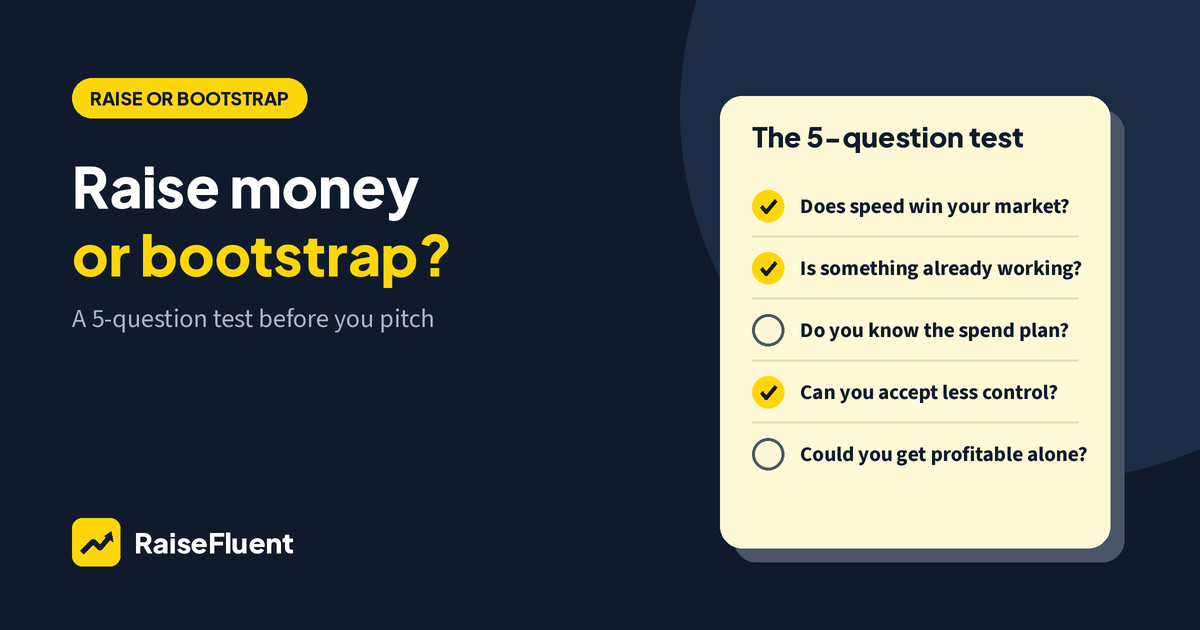
The 5-question test
Answer these five questions honestly. They are the same ones I walk through in Chapter 3 of the eBook.
- 1. Does speed actually win in your market? If the winner is the first to scale, think marketplaces, network effects, land-grabs, outside money multiplies your odds. If customers choose on trust, quality or relationships, slow and profitable often beats fast and funded.
- 2. Is something already working? Not "I have a deck." A thing: users returning, revenue growing, retention holding. Investors fund evidence that money will accelerate a working engine. Funding hope is the most expensive money there is.
- 3. Do you know what you will spend it on? If the answer is "more months of runway," you are buying time, not velocity. Time is cheaper to buy with revenue.
- 4. Can you accept losing control? A board seat, protective provisions, a raise schedule you do not set. If that makes your stomach drop, bootstrapping keeps you the boss, including of your own mistakes.
- 5. Could you reach profitability on your own? If yes, you are negotiating from strength or not at all. If no, understand exactly which milestone closes that gap, and how much equity reaching it costs.
When raising is the right call
Raise when three things are true at once: the market rewards speed, you have real evidence the engine works, and the money buys a specific, known acceleration, such as a sales team, a second market, or the engineering that turns a pilot into a product. Raise from investors who match your stage and sector, and know your numbers cold before the first meeting.
When to bootstrap instead
Bootstrap when customers will fund the company, when the path from sale to sale is short and each sale teaches you something. The best bootstrapped companies treat revenue as the only investor that never dilutes them. You keep control, you build a habit of discipline venture money often erodes, and if you ever do raise, you do it from strength: a working business negotiating with money, not begging for it.
What to do this week
Write one paragraph: "In 24 months this company is worth more because we raised", or the opposite. If you cannot write it honestly, you have your answer. If you can, run the numbers: how much, at what valuation, and what that costs you across three rounds, not one. The free Dilution Calculator does that in five minutes.
Tool for this article
Get the free eBook
Fund or Fold: 19 chapters on fundraising, free for first-time founders.
The Fluent Founder
One practical fundraising lesson every week, from real deals. Free.