
· 12 min read
What Is a SAFE? How SAFE Notes Work, With Real Examples
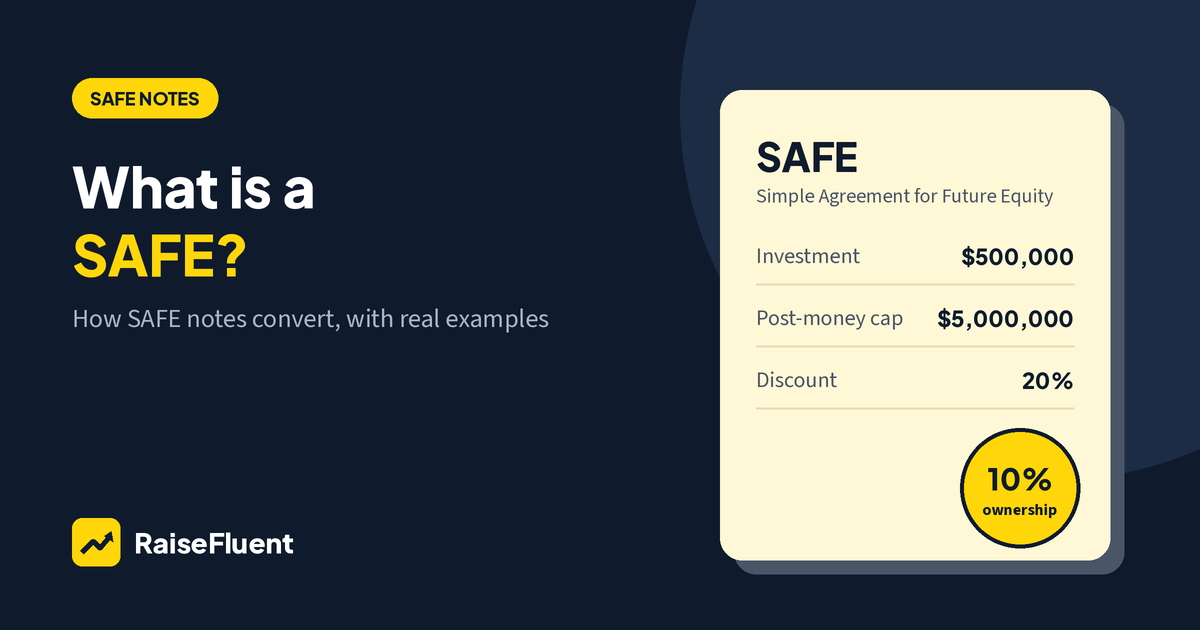
A SAFE (Simple Agreement for Future Equity) is a contract where an investor gives your startup money today in exchange for the right to receive shares later, usually at your next priced funding round. It is not debt, it has no interest rate and no maturity date. Most SAFEs set a valuation cap, sometimes a discount, and convert into shares automatically when you raise a priced round.
SAFEs were introduced by Y Combinator in 2013, and the post-money version followed in 2018. They have since become the default for early rounds. According to Carta, about 93% of pre-seed rounds on its platform used SAFEs as of mid 2026, and about 91% of those SAFEs were post-money.
That popularity is exactly why founders need to understand them. A SAFE is quick to sign, but the ownership it gives away is very real. This guide shows you how SAFEs work, how they convert and how to avoid the most common and expensive mistakes.
FREE CALCULATOR
SAFE Calculator
See what your SAFEs convert into before you sign.
How a SAFE works, step by step
- An investor gives you money now. For example, $500,000.
- You agree on the terms. Usually a valuation cap, sometimes a discount, and sometimes extra rights in a side letter.
- No shares are issued yet. The investor holds a SAFE, not stock. They do not appear on your cap table as a shareholder yet.
- At your next priced round, the SAFE converts. The investor receives shares at the price set by the cap or the discount, whichever is better for them.
If the company is sold before a priced round, the investor typically gets the greater of their money back or the amount their shares would be worth at the cap. If the company shuts down, SAFE holders usually rank ahead of common shareholders for whatever is left, though often there is very little.
The key terms in a SAFE
Valuation cap
The cap is the maximum valuation at which the SAFE converts. It protects the investor if your company grows a lot before the priced round.
In a post-money SAFE, the cap includes all the SAFE money raised. That makes the math very simple:
Investor ownership = SAFE amount ÷ post-money valuation cap
A $500,000 SAFE with a $5,000,000 post-money cap gives the investor 10% of the company, measured just before your priced round.
Discount
A discount lets the SAFE convert at a lower price than new investors pay in the priced round. A 20% discount is common. If new investors pay $1.00 per share, a 20% discount means the SAFE converts at $0.80 per share.
Cap and discount together
When a SAFE has both, the investor gets whichever gives them the lower price, and therefore more shares. You never get the worse of both.
Most favored nation (MFN)
An MFN clause says that if you later sign a SAFE with better terms, this investor can take those better terms too. It often appears in uncapped SAFEs.
Pro rata rights
Some investors ask for the right to invest more in your next round to keep their ownership percentage. In the standard post-money SAFE, this sits in a separate side letter.
Example 1: the cap applies
You raise $500,000 on a post-money SAFE with a $5,000,000 cap and a 20% discount.
Later, you raise a priced seed round at an $8,000,000 pre-money valuation.
- Using the cap: the SAFE converts as if the company were worth $5,000,000.
- Using the discount: the price is 20% below the round, equivalent to a $6,400,000 valuation ($8,000,000 × 0.8).
- The cap gives the lower price, so the cap applies. The investor owns 10% before the seed money comes in.
Example 2: the discount applies
Same $500,000 SAFE with a 20% discount, but this time the cap is $10,000,000. The priced round is again at an $8,000,000 pre-money valuation.
- Using the cap: a $10,000,000 valuation.
- Using the discount: a $6,400,000 valuation.
- The discount gives the lower price, so the discount applies. The investor owns about $500,000 ÷ $6,400,000 = 7.8%.
If that seed round raises $2,000,000 at the $8,000,000 pre-money valuation, the new investors buy 20%. The founders, who held 92.2% after the SAFE, end up with about 73.8%.
FREE EBOOK
Get the free Fund or Fold eBook
19 chapters, free by email.
Example 3: how stacked SAFEs add up
This is where founders get surprised. Imagine you raise three SAFEs over 18 months as your company grows:
| SAFE | Amount | Post-money cap | Ownership |
|---|---|---|---|
| SAFE 1 | $500,000 | $5,000,000 | 10% |
| SAFE 2 | $750,000 | $7,500,000 | 10% |
| SAFE 3 | $1,000,000 | $10,000,000 | 10% |
| Total | $2,250,000 | 30% |
Each SAFE felt like "only 10%". Together, they commit 30% of your company before your first priced round. Founders now hold 70%.
Then you raise a $2,000,000 seed round at an $8,000,000 pre-money valuation. The new investors buy 20%, and everyone before them is diluted, so founders go from 70% to 56%. Add an option pool created before the round and the number drops further.
With post-money SAFEs, each new SAFE dilutes the founders, not the earlier SAFE holders. That is good for investors and simple to calculate, but it means every additional SAFE comes almost entirely out of your share.
Post-money vs pre-money SAFE
The original 2013 SAFE was a pre-money SAFE. Ownership was only clear once the priced round happened, and SAFE holders diluted each other as well as the founders.
The post-money SAFE, introduced in 2018, fixes each investor's ownership the moment they sign. It is easier for everyone to understand, which is why it is now the standard. The trade-off is that founders absorb the dilution from each new SAFE.
| Pre-money SAFE | Post-money SAFE | |
|---|---|---|
| Cap includes SAFE money? | No | Yes |
| Investor ownership known at signing? | No | Yes |
| New SAFEs dilute earlier SAFE holders? | Yes | No |
| Who absorbs dilution from new SAFEs? | Founders and SAFE holders | Mostly founders |
| Common today? | Rare | Standard |
For a deeper look at how pre-money and post-money figures work in priced rounds, read Pre-money vs post-money valuation explained.
SAFE vs convertible note
Both are ways to raise money now and convert to shares later. The difference is that a convertible note is a loan.
| SAFE | Convertible note | |
|---|---|---|
| Is it debt? | No | Yes |
| Interest rate | None | Usually 2% to 8% a year |
| Maturity date | None | Usually 12 to 24 months |
| Repayment risk | None | Can be called if not converted |
| Paperwork | Short, standard | Longer, more negotiated |
For most early-stage founders, a SAFE is simpler and less risky. Convertible notes remain common in some markets and with some investors, so it is worth knowing both.
When a SAFE is the right choice
A SAFE usually makes sense when:
- You are raising a small pre-seed or bridge round, often under about $2,000,000.
- You want to close investors one by one, as each one commits, instead of all on the same day.
- Legal costs for a full priced round would be a big share of the money raised.
- You and your investors are comfortable with a cap, without setting a full valuation today.
A priced round usually makes more sense when you are raising a larger amount, when a lead investor wants board seats and detailed rights, or when you already have several SAFEs outstanding and need a clean cap table.
FUNDRAISING KIT
Fundraising Kit waitlist
Lock the $249 early-bird price. No payment now.
How to negotiate a SAFE
The standard SAFE documents are short, so there are only a few levers. Use them well.
- The cap is the main lever. Anchor it to the round you expect to raise next, not to the highest number you have heard. A cap you can comfortably grow past makes the conversion clean.
- Cap or discount, not always both. Many early SAFEs have a cap only. If an investor wants both, a 20% discount is the common ceiling.
- Keep side letters light. Pro rata rights are reasonable for investors who will genuinely add value. Information rights and board observer seats on a small SAFE are rarely necessary.
- Raise in tranches on purpose. It is fine to raise the first $250,000 at a lower cap and later money at a higher cap as you hit milestones. Just track the total so it does not drift past what you meant to sell.
- Set a stopping point. Decide in advance the maximum share of the company you will sell on SAFEs before a priced round, for example 20%, and hold to it.
From the deal room: the 10% that became 27%
A pattern I have seen many times goes like this. A first-time founder raises a $300,000 SAFE at a $3,000,000 post-money cap from an angel. That is 10%. A few months later, a second angel offers $400,000 at a $4,000,000 cap, another 10%. Then a small fund offers $350,000 at a $5,000,000 cap, another 7%.
Each conversation felt like a win, and each SAFE was easy to sign. Nobody added them up. When a seed investor finally asked for the cap table, the founder discovered that 27% of the company was already committed, before the seed round, before the option pool and before any employee grants.
The seed investor did not walk away, but the negotiation changed. The founder had less room to give, and the investor knew it. A single sheet with a running total, updated after each SAFE, would have shown the problem by the second signature.
Common SAFE mistakes founders make
- Not keeping a running total. Keep one sheet with every SAFE, its amount, cap and discount, and model the total before you sign another one.
- Treating the cap as your valuation. A cap is a ceiling for conversion, not a price. A high cap with a generous discount can still convert at a much lower price.
- Ignoring the next round. A SAFE's real cost shows up when it converts. Model it alongside your expected seed round, not on its own.
- Signing uncapped SAFEs without an MFN. If an early SAFE has no cap and no MFN, a later SAFE with a cap can leave the early investor in a worse spot, which creates friction you do not need.
- Skipping the lawyer. The standard documents are short, but side letters and edits matter. Have a startup lawyer review anything you sign.
FAQ
What is a SAFE note?
A SAFE (Simple Agreement for Future Equity) is an agreement where an investor gives a startup money now in exchange for shares later, usually at the next priced funding round. It is often called a SAFE note, even though it is not a loan.
How does a post-money SAFE convert?
The investor's ownership equals the SAFE amount divided by the post-money valuation cap, measured just before the priced round. If the SAFE also has a discount, the investor gets whichever gives the lower price.
Is a SAFE debt?
No. A SAFE has no interest rate, no maturity date and no repayment obligation. A convertible note, by contrast, is a loan that converts into shares.
What is a good valuation cap for a SAFE?
It depends on your stage, traction and market. A good cap is one you can grow into by your next round. A cap set too high can make the priced round harder.
How many SAFEs is too many?
There is no fixed number, but once SAFEs add up to more than 20% to 25% of the company, the priced round becomes harder and founders often feel the squeeze.
Your next step
Before you sign your next SAFE:
- Model it in the free SAFE Calculator, including every SAFE you have already signed.
- Read the full framework in the free Fund or Fold eBook, which covers when to raise and how to keep control of your cap table.
Mohit Patel has spent 10+ years on both sides of the deal table, working with 750+ founders and business owners and 2,500+ investors. He is the author of Fund or Fold and the founder of RaiseFluent. Connect on LinkedIn.
This article is educational and not legal, tax or investment advice. Always check the exact terms in the SAFE you sign.
The Fluent Founder
One practical fundraising lesson every week, from real deals. Free.