
· 10 min read
Pre-Money vs Post-Money Valuation: The Difference, With Formulas
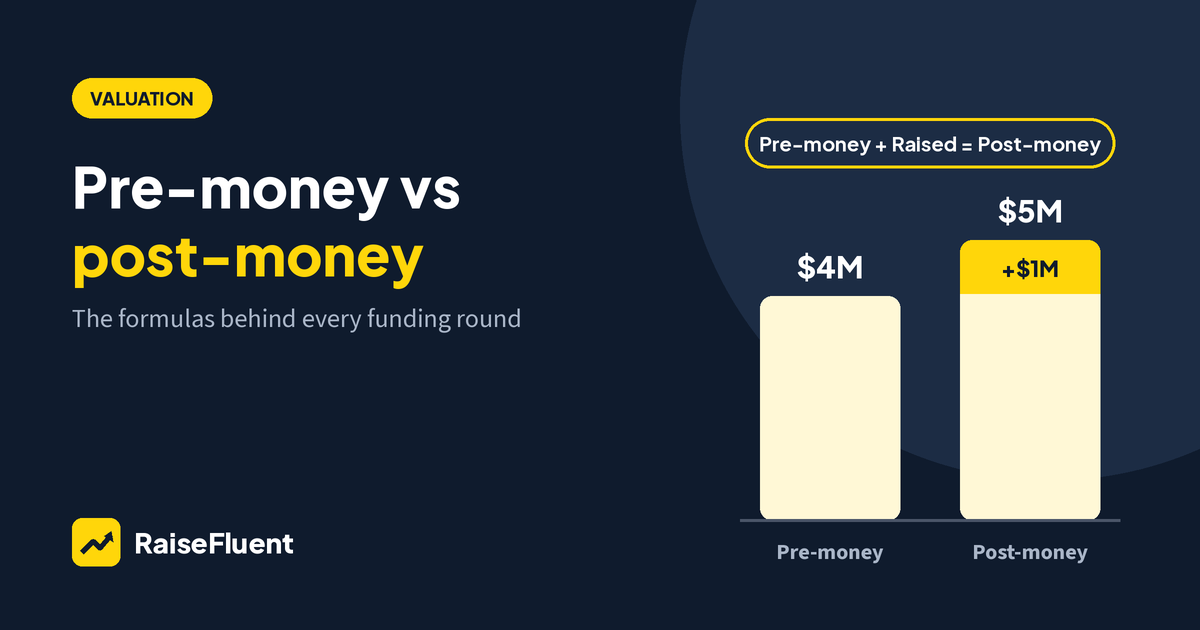
Pre-money valuation is what your company is worth just before new investment comes in. Post-money valuation is what it is worth right after: the pre-money valuation plus the money raised. The investor's ownership is always the amount they invest divided by the post-money valuation.
It sounds like a small technical detail. It is not. A "$5 million valuation" can cost you 20% of your company or about 16.7%, depending on which one the investor means. On a real round, that gap can be worth hundreds of thousands of dollars.
This guide gives you the formulas, three worked examples and the questions to ask so you never compare two offers on the wrong basis.
FREE CALCULATOR
Pre-Money vs Post-Money Calculator
Turn any valuation into ownership and price per share.
The three formulas you need
Everything in this guide comes from three simple formulas.
1. Post-money valuation = pre-money valuation + amount raised
2. Investor ownership = amount raised ÷ post-money valuation
3. Price per share = pre-money valuation ÷ shares that exist before the round
You can also work backwards:
- Pre-money valuation = post-money valuation − amount raised
- Post-money valuation = amount raised ÷ investor ownership
That last one is handy when an investor says "we'll put in $2 million for 20%". It means a $10,000,000 post-money valuation and an $8,000,000 pre-money valuation.
Example 1: a simple priced round
You raise $1,000,000 at a $4,000,000 pre-money valuation. You have 4,000,000 shares today.
- Post-money valuation = $4,000,000 + $1,000,000 = $5,000,000
- Investor ownership = $1,000,000 ÷ $5,000,000 = 20%
- Existing shareholders keep 80%
- Price per share = $4,000,000 ÷ 4,000,000 = $1.00
- New shares issued to the investor = $1,000,000 ÷ $1.00 = 1,000,000 shares
Check it: the investor holds 1,000,000 of 5,000,000 total shares, which is 20%. The numbers agree.
Example 2: the same headline, two different deals
Two investors each offer $1,000,000 at a "$5 million valuation".
Investor A means $5,000,000 post-money.
- Ownership = $1,000,000 ÷ $5,000,000 = 20%
- Pre-money = $4,000,000
Investor B means $5,000,000 pre-money.
- Post-money = $5,000,000 + $1,000,000 = $6,000,000
- Ownership = $1,000,000 ÷ $6,000,000 = 16.7%
| Investor A | Investor B | |
|---|---|---|
| Headline | "$5M valuation" | "$5M valuation" |
| Actually means | $5M post-money | $5M pre-money |
| Investor ownership | 20% | 16.7% |
| You keep | 80% | 83.3% |
Same investment, same headline, a 3.3 point difference in ownership. If the company later sells for $50,000,000, that difference is worth about $1,650,000 to you before any later dilution.
Always ask: "Is that pre-money or post-money?" And get the answer in writing.
FREE EBOOK
Get the free Fund or Fold eBook
19 chapters, free by email.
Example 3: the option pool changes everything
Many investors ask you to create or expand an employee option pool as part of the round. Where that pool sits changes your real valuation.
Say you raise $2,000,000 at an $8,000,000 pre-money valuation, and the investor asks for a 10% option pool created before the round.
- Post-money valuation = $10,000,000
- The investor owns 20%
- The new pool is 10% of the post-money company, worth $1,000,000
- Because the pool is created before the round, existing shareholders pay for all of it
Existing shareholders end up with 70% of the company, not 80%. In effect, the $8,000,000 pre-money valuation is really $7,000,000 for you. This is often called the effective pre-money valuation, and the trick behind it is known as the option pool shuffle.
If the pool were created after the round, everyone, including the new investor, would share its cost, and existing shareholders would keep 72% instead of 70%.
FREE CALCULATOR
Option Pool Calculator
Find your effective pre-money valuation in seconds.
Pre-money and post-money across several rounds
Each round's post-money valuation is the starting point for thinking about the next one, but the next round's pre-money is set fresh by the new investors, based on how much the company has grown. Here is a fictional company over three rounds, assuming no new option pool after the seed:
| Round | Pre-money | Raised | Post-money | New investors own | Founders after |
|---|---|---|---|---|---|
| Pre-seed | $2,000,000 | $500,000 | $2,500,000 | 20% | 80% |
| Seed | $8,000,000 | $2,000,000 | $10,000,000 | 20% | 64% |
| Series A | $24,000,000 | $6,000,000 | $30,000,000 | 20% | 51.2% |
Two things stand out.
First, the step-up: the seed pre-money ($8,000,000) is more than three times the pre-seed post-money ($2,500,000). That jump is what the pre-seed money was supposed to buy. If the next pre-money comes in at or below the last post-money, that is a flat or down round, and earlier investors may have anti-dilution rights that cost founders more.
Second, the compounding: selling "only 20%" three times leaves founders with about half the company. Each round looks reasonable on its own. The total is what matters.
How investors arrive at your pre-money valuation
At the early stage, pre-money valuation is a negotiation, not a formula. Investors usually work backwards from three things:
- How much you need to raise. If you need $2,000,000 and the market norm at your stage is selling about 20%, the post-money lands near $10,000,000 and the pre-money near $8,000,000.
- Comparable deals. What similar companies in your sector, stage and region raised at recently.
- Your evidence. Revenue, growth, retention, team and competition for the deal. Strong evidence and several interested investors move the number up.
Methods like Berkus, Scorecard and revenue multiples give you a defensible range to start from. The Startup Valuation Calculator runs all three.
From the deal room: the "valuation" that wasn't
One pattern I have seen many times goes like this. A founder receives two offers. Offer one is "$2 million at $10 million". Offer two is "$2 million at $9 million, post". The founder assumes the first offer is better, because $10 million is bigger than $9 million.
Then the details arrive. The first offer is pre-money, but it comes with a 15% option pool created before the round. The second is post-money, with no new pool. Once the founder runs both properly, the first offer leaves the founding team with about 68.3% and the second with about 77.8%. The "lower" valuation is worth nearly 10 points more ownership.
Nobody was hiding anything. The founder simply compared two numbers that were not measuring the same thing. Five minutes with the formulas above would have shown it.
What "fully diluted" means
When investors talk about valuation and ownership, they usually mean fully diluted: counting not just issued shares, but also every option, warrant, the unissued option pool and any SAFEs or notes that will convert.
This matters for your price per share. If you calculate the price using only the shares you have issued, but the investor uses the fully diluted count, the investor's price is lower and they get more shares for the same money. Agree on the share count, not just the valuation.
How SAFEs use pre-money and post-money
SAFEs come in two versions:
- A post-money SAFE uses a post-money valuation cap. The investor's ownership is simply the SAFE amount divided by the cap. A $500,000 SAFE with a $5,000,000 post-money cap is 10%.
- A pre-money SAFE uses a pre-money cap, so the final ownership is only clear when the priced round happens.
Most SAFEs today are post-money. What is a SAFE? explains how both convert, with examples.
How to compare two offers properly
When you have more than one offer, line them up on the same basis:
- Convert every offer to post-money. Use investor ownership = amount ÷ post-money.
- Include the option pool. Ask whether it is created before or after the round, and calculate your ownership after the pool.
- Check the other terms. Liquidation preference, participation and board seats can matter more than a small valuation difference. Liquidation preference explained shows how.
- Look at what you take home, not only the percentage, at a few realistic exit values.
The Term Sheet Comparison does all four side by side.
FUNDRAISING KIT
Fundraising Kit waitlist
Lock the $249 early-bird price. No payment now.
Common mistakes founders make
- Assuming everyone means the same thing by "valuation". Always confirm pre-money or post-money.
- Forgetting the option pool. A pre-money pool lowers your effective valuation, sometimes by more than a tougher headline number would.
- Using the wrong share count. Agree on a fully diluted share count before you agree on a price.
- Comparing headline numbers across offers. Convert everything to your ownership after the round, including the pool.
- Chasing the highest number. A valuation you cannot grow into makes your next round harder. Read Startup dilution explained to see how each round compounds.
FAQ
What is the difference between pre-money and post-money valuation?
Pre-money valuation is the value of a company just before new investment. Post-money valuation is the value right after, which equals the pre-money valuation plus the amount raised.
How do you calculate post-money valuation?
Add the amount raised to the pre-money valuation. You can also divide the amount raised by the investor's ownership percentage: $2,000,000 for 20% means a $10,000,000 post-money valuation.
Which valuation do investors usually quote?
It varies. SAFEs usually use a post-money cap, while priced rounds are often discussed in pre-money terms. Always confirm in writing.
How does the option pool affect pre-money valuation?
If the option pool is created before the round, its full cost falls on existing shareholders, so your effective pre-money valuation is lower than the headline number.
How is price per share calculated?
Divide the pre-money valuation by the number of fully diluted shares that exist before the round.
Your next step
Next time an investor names a valuation:
- Run the numbers in the free Pre-Money vs Post-Money Calculator.
- Read the full framework in the free Fund or Fold eBook, which covers how to size your round and negotiate it.
Mohit Patel has spent 10+ years on both sides of the deal table, working with 750+ founders and business owners and 2,500+ investors. He is the author of Fund or Fold and the founder of RaiseFluent. Connect on LinkedIn.
This article is educational and not legal, tax or investment advice. Examples are illustrative.
The Fluent Founder
One practical fundraising lesson every week, from real deals. Free.