
· 11 min read
Startup Dilution Explained: How Much Equity You Really Give Up
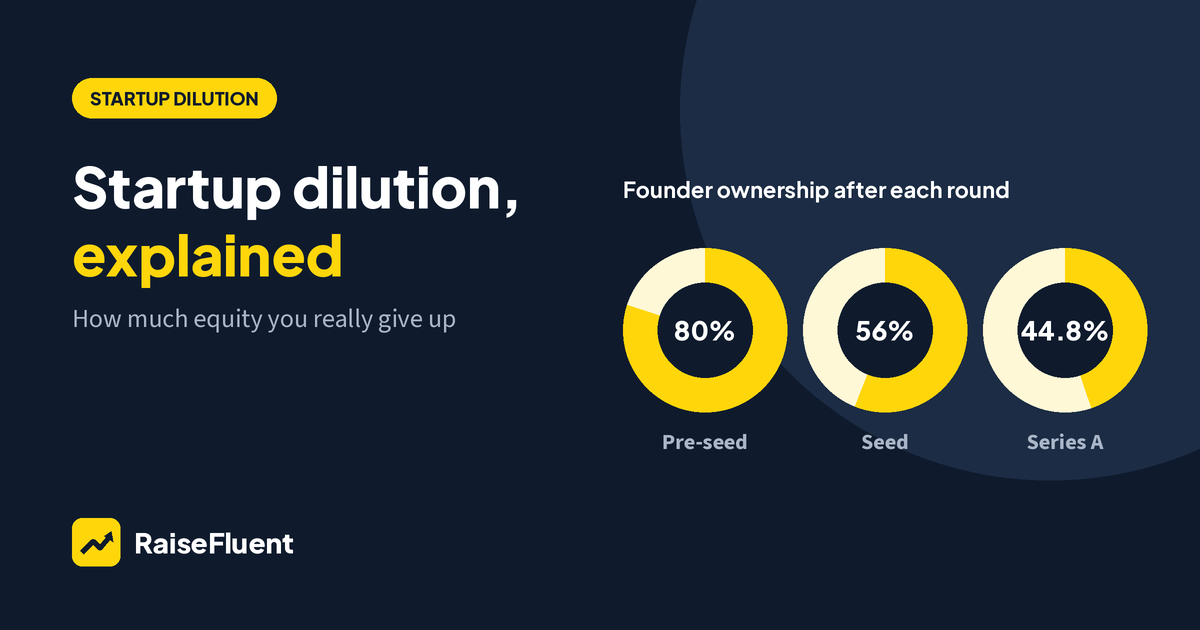
Startup dilution is the drop in your ownership percentage every time your company issues new shares, usually to investors or to an employee option pool. You keep the same number of shares, but there are more shares in total, so your slice gets smaller. A typical seed or Series A round dilutes founders by about 15% to 25%, and the option pool can quietly add several more points on top.
That is the short answer. The rest of this guide shows you how dilution actually works round by round, what is normal, where founders lose more than they need to and how to model your own numbers before you sign anything.
I have spent more than 10 years on both sides of the deal table, working with 750+ founders and business owners and 2,500+ investors. The founders who regret their first round rarely regret the valuation. They regret not understanding what they would own two rounds later.
FREE CALCULATOR
Dilution Calculator
Model up to 3 rounds and see exactly what you keep.
What dilution actually means
Imagine your company has 10,000,000 shares and you own all of them. You own 100%.
An investor wants to put in money, so the company creates 2,500,000 new shares and sells them to that investor. There are now 12,500,000 shares in total. You still hold your 10,000,000 shares, but they are now 80% of the company instead of 100%.
That 20 point drop is dilution. Nobody took your shares away. The pie got bigger and your piece became a smaller fraction of it.
This is the part many first-time founders miss: dilution is not a loss by itself. If the money helps the company grow, 80% of a bigger, better funded company can be worth far more than 100% of the company you had before.
How to calculate dilution in one formula
For any single round, the math is simple:
Your ownership after the round = your ownership before × (1 − the percentage sold in the round)
The percentage sold in a priced round is:
Percentage sold = amount raised ÷ post-money valuation
And the post-money valuation is:
Post-money valuation = pre-money valuation + amount raised
So if you raise $2,000,000 at an $8,000,000 pre-money valuation:
- Post-money valuation = $8,000,000 + $2,000,000 = $10,000,000
- Percentage sold = $2,000,000 ÷ $10,000,000 = 20%
- If you owned 80% before the round, you own 80% × (1 − 0.20) = 64% after it
If any of those terms feel fuzzy, read Pre-money vs post-money valuation explained first. It is the foundation for everything else here.
A worked example across three rounds
Numbers make this real. Here is a fictional company raising three rounds, in the range many startups see.
Pre-seed: $500,000 at a $2,000,000 pre-money valuation. Post-money is $2,500,000, so the investors buy 20%. Founders go from 100% to 80%.
Seed: $2,000,000 at an $8,000,000 pre-money valuation. The investors also ask for a 10% option pool, created before the round. Founders go from 80% to 56%.
Series A: $6,000,000 at a $24,000,000 pre-money valuation. Post-money is $30,000,000, so the new investors buy 20%. Founders go from 56% to 44.8%.
| Round | Raised | Pre-money | Post-money | Founders after |
|---|---|---|---|---|
| Start | 100% | |||
| Pre-seed | $500,000 | $2,000,000 | $2,500,000 | 80% |
| Seed (with 10% pool) | $2,000,000 | $8,000,000 | $10,000,000 | 56% |
| Series A | $6,000,000 | $24,000,000 | $30,000,000 | 44.8% |
Now look at the value, not just the percentage. At the start, the founders owned 100% of a company with no outside valuation. After the Series A, they own 44.8% of a company valued at $30,000,000. On paper, that stake is worth about $13,440,000.
That is the trade every funding round makes. You give up percentage to buy growth. Dilution only hurts when the growth never comes.
Why the seed round cost more than 20%
Look closely at the seed round above. The investors bought 20%, yet the founders dropped from 80% to 56%, a fall of 24 points, which is 30% of what they held.
The extra cost came from the option pool.
When investors ask for an option pool "in the pre-money", the new shares for future employees are created before the investors put in their money. That means the pool dilutes only the existing shareholders, not the new investors. Here is what happens in this example:
- The new investors own 20% of the company after the round.
- The new option pool is 10% of the company after the round.
- Everything else, 70%, belongs to the shareholders from before the round.
- The founders held 80% of that pre-round group, so they now own 80% × 70% = 56%.
If the same pool had been created after the round, the investors would share its cost. Founders would end up with a little more. This is called the option pool shuffle, and it is one of the most common ways founders give up more than the headline numbers suggest.
There is another way to see it. The pool is worth 10% of $10,000,000, which is $1,000,000. Because the founders pay for all of it, the $8,000,000 pre-money valuation is really worth $7,000,000 to them. The investor's offer looks like an $8 million valuation, but the founders receive the economics of a $7 million one.
FREE CALCULATOR
Option Pool Calculator
See your effective pre-money valuation before you agree to a pool.
How much dilution is normal per round?
There is no fixed rule, but recent market data gives a useful range. Carta's recent benchmarks put the median dilution at about 18% for seed rounds and 18% for Series A rounds, falling to about 12% at Series B. Its founder ownership data shows the median founding team owning roughly 56% after the seed round and roughly 36% after the Series A.
As a working guide:
| Stage | Typical dilution per round |
|---|---|
| Pre-seed (often on SAFEs) | 10% to 15% |
| Seed | 15% to 25% |
| Series A | 15% to 25% |
| Series B and later | 10% to 15% |
Treat these as ranges, not targets. The right number for you depends on how much you need to raise, how strong your traction is and how competitive your round is. A founder with three term sheets negotiates very differently from a founder with one.
What matters more than any single round is the total. If you sell 25% in each of four rounds, you keep about 32% before any option pool. Sell 18% in each and you keep about 45%. That difference compounds, so a few points saved early are worth fighting for.
FREE EBOOK
Get the free Fund or Fold eBook
19 chapters, free by email.
The hidden sources of dilution
New investors are only the most visible cause of dilution. Watch for these too.
1. The option pool
Covered above. Ask for the pool to be sized to your actual hiring plan for the next 18 to 24 months, not a generic 15% or 20%. A pool larger than you need is a hidden cut to your valuation.
2. SAFEs and convertible notes
SAFEs feel painless because no shares change hands on the day you sign. But they convert at your next priced round, and the dilution lands all at once. Founders who stack several SAFEs are often surprised by how much of the company is already committed. What is a SAFE? walks through exactly how they convert.
3. Anti-dilution protection
Many priced rounds give investors anti-dilution rights. If you later raise at a lower valuation (a down round), these rights give the earlier investors extra shares, which dilutes founders further. A broad-based weighted average clause is standard and fairly mild. A full ratchet clause is much harsher and worth pushing back on.
4. Advisor and early employee grants
Small grants add up. Five advisors at 0.5% each is 2.5% of your company. Make sure every grant vests over time, so equity only goes to people who keep contributing.
How to keep more of your company
You cannot avoid dilution if you raise, but you can control how much you give up.
- Raise what you need, not what you can. Every extra dollar raised at the same valuation costs you ownership. Base your round on your burn, your next milestone and a sensible buffer. The Funding Goal Calculator helps you size it.
- Build leverage before you raise. Traction, revenue and competing interest are what move valuation. The best time to raise is when you do not urgently need to.
- Negotiate the option pool, not only the valuation. Bring a hiring plan that justifies a smaller pool. Two or three points saved here can be worth more than a higher headline valuation.
- Track your SAFEs. Keep a running total of everything you have signed and model the conversion before you sign another one.
- Model the next round, not just this one. Use the Cap Table Calculator to see where you will be after your Series A, not only after the current deal.
FUNDRAISING KIT
Fundraising Kit waitlist
Lock the $249 early-bird price. No payment now.
From the deal room: the founder who won the valuation and lost the round
A pattern I have seen many times goes like this. A founder negotiates hard on valuation and gets the investor from $8,000,000 to $10,000,000 pre-money on a $2,000,000 round. It feels like a big win.
But the investor quietly raises the option pool request from 10% to 20%, created before the round. With the lower valuation and the smaller pool, the founders would have kept 70% of the company before any other holders. With the higher valuation and the bigger pool, they keep about 63.3%.
The founder won the headline and lost almost 7 points of ownership. The investor's own stake fell by only about 3 points, from 20% to 16.7%, because the bigger pool came entirely out of the founders' side. Always model the full package, not the number that gets announced.
Common dilution mistakes founders make
- Focusing on valuation alone. A higher valuation with a big pre-money option pool can leave you with less than a lower valuation with a small one.
- Ignoring the option pool shuffle. If you do not ask whether the pool is pre-money or post-money, assume it is pre-money.
- Raising on several SAFEs without a total. Each SAFE looks small. Together they can take 20% to 30% of the company before your first priced round.
- Giving unvested equity. Equity for cofounders, advisors and employees should vest, usually over four years with a one-year cliff.
- Panicking about the percentage. A smaller slice of a much more valuable company is the point of raising. Judge each round by what the money will let you build.
FAQ
What is startup dilution?
Startup dilution is the reduction in an existing shareholder's ownership percentage when the company issues new shares, for example to investors in a funding round or to an employee option pool.
How much equity should I give investors in a seed round?
Many seed rounds sell 15% to 25% of the company, with recent medians near 18%. The right amount depends on how much you need to raise and the valuation you can justify.
Does dilution reduce the number of shares I own?
No. You keep the same number of shares. The company creates new shares, so your shares become a smaller percentage of the total.
How much should founders own after Series A?
There is no fixed rule. Recent data shows the median founding team owning around a third of the company after Series A, and many investors like to see founders keep enough to stay motivated through several more rounds.
Is dilution always bad?
No. If the money from a round makes the company grow faster, a smaller percentage of a more valuable company can be worth much more. Dilution only hurts when the money does not create enough extra value.
Your next step
Before your next investor conversation:
- Model your rounds in the free Dilution Calculator to see what you will keep after each one.
- Read the full framework in the free Fund or Fold eBook, which covers when to raise and how much to raise and when it is smarter to walk away.
Mohit Patel has spent 10+ years on both sides of the deal table, working with 750+ founders and business owners and 2,500+ investors. He is the author of Fund or Fold and the founder of RaiseFluent. Connect on LinkedIn.
This article is educational and not legal, tax or investment advice. Examples are illustrative.
The Fluent Founder
One practical fundraising lesson every week, from real deals. Free.